
Bible · Prophecy & the Controversy · ~38 min read
The pattern in the sanctuary.
God once designed a tent down to the inch and filled it with furniture that turns out to be the whole plan of salvation drawn in gold and linen and blood — the cross, the law, and the judgment in one blueprint. One line of prophecy carries it to a date the world has worked very hard to bury: 1844. This is the sanctuary, and the long campaign against it.
By George Hinestrosa · Personal study & research
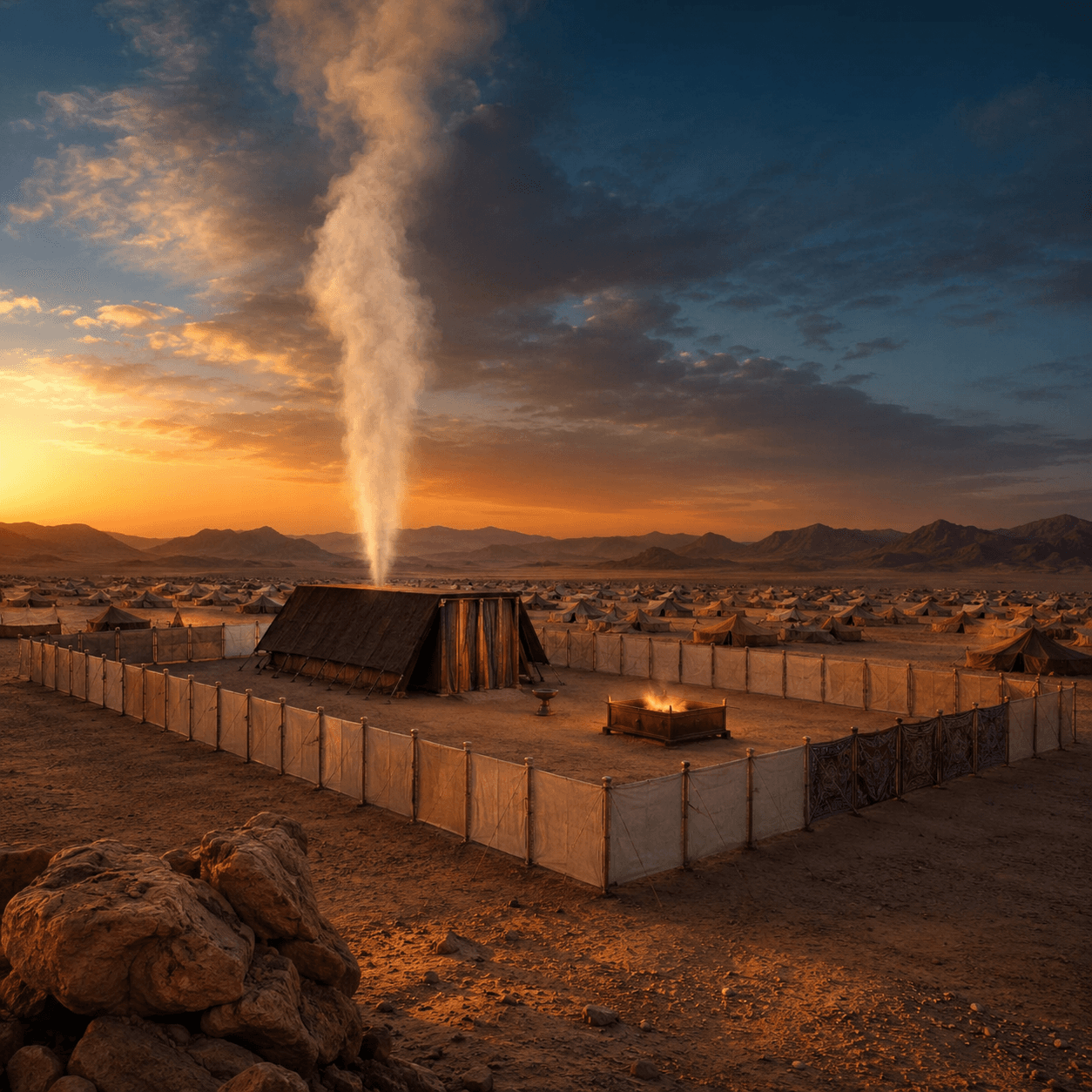
At the foot of Sinai, God gave Moses a strange and beautiful instruction. Not first a temple of cedar and gold — that would come later — but a portable tent, a tabernacle, to be built down to the last loop and socket according to an exact heavenly pattern. And He told Moses plainly why He wanted it:
“And let them make me a sanctuary; that I may dwell among them.”
— Exodus 25:8, KJV
That is the whole heart of it. The sanctuary is God moving back in with a people who had driven Him out by sin. But it is more than a meeting place. Every board, every color, every piece of furniture, every step of its daily ritual is a teaching model — the gospel acted out in advance, the entire ministry of the coming Saviour built into a building so that a person walking through it would be walking through the plan of his own salvation. Read it slowly and it gives back the cross, the priesthood, and the judgment, all in order. Most people never read it at all — and, as we will see, that is no accident.
Part One — The Pattern
First, there had to be a law
A sanctuary exists to deal with sin, so the place to start is the definition of sin itself — and Scripture gives one, exact and plain:
“Whosoever committeth sin transgresseth also the law: for sin is the transgression of the law.”
— 1 John 3:4, KJV
Sin is the breaking of God’s law, and “where no law is, there is no transgression” (Romans 4:15). There were, in fact, two laws at Sinai, and the whole sanctuary turns on telling them apart. One was the moral law — the Ten Commandments, written by God’s own finger in stone (Exodus 31:18), and laid up inside the ark itself (Deuteronomy 10:2-5). The other was the ceremonial law — the system of feasts and offerings and rituals, written by Moses’s hand in a book, “added because of transgressions” (Galatians 3:19), and laid beside the ark, “for a witness against thee” (Deuteronomy 31:24-26). One was God’s unchanging character in stone; the other a temporary schoolmaster of shadows, pointing forward to Christ. (The Sabbath article, The Day the Church Set Aside, walks through that distinction in full.)
The wages of breaking the moral law is death (Romans 6:23). So humanity stood condemned, and God faced an impossible-looking choice. He could simply repeal the law — erase the rule and erase the crime. But God does not change His own character (Malachi 3:6), and a law that could be set aside whenever it became inconvenient was never really a law at all. Instead He did the costlier thing: He kept the law, and paid its penalty Himself. Which means the cross is not the end of the law — it is the law’s loudest vindication:
“Do we then make void the law through faith? God forbid: yea, we establish the law.”
— Romans 3:31, KJV
Had it been possible to take the law away, Christ need not have died. That He died is the proof the law still stands. None of this is earning anything — “by grace are ye saved through faith… not of works” (Ephesians 2:8-9). The law cannot save anyone; it can only show what sin is and pronounce the sentence. Salvation is a gift. But grace does not abolish the law it forgives — it writes it on the heart (Hebrews 10:16). Hold that, because the entire sanctuary is built on it: a real law, a real penalty, and a real Substitute.
A copy of the real thing
Twice God warned Moses to build it exactly — “See… that thou make all things according to the pattern shewed to thee in the mount” (Exodus 25:40). The insistence on precision is the first clue: this tent is a scale model of something that already exists.
“We have such an high priest, who is set on the right hand of the throne of the Majesty in the heavens; A minister of the sanctuary, and of the true tabernacle, which the Lord pitched, and not man.”
— Hebrews 8:1-2, KJV
There is a real sanctuary in heaven, the one the Lord pitched, and Christ is its high priest. The desert tabernacle was its copy — “the figures of the true” (Hebrews 9:24) — given so that a people who could not yet see the heavenly ministry could watch it play out in miniature. So to study the furniture is to study what Jesus is actually doing. That is not antiquarian curiosity; it is the difference between knowing your Saviour at the cross and knowing Him as the living Priest He has been ever since.
Through the one gate
The whole structure stood inside a courtyard walled with white linen — a wall of righteousness — and that wall had a single opening. One gate. Not many doors, not many ways in:
“I am the door: by me if any man enter in, he shall be saved.”
— John 10:9, KJV
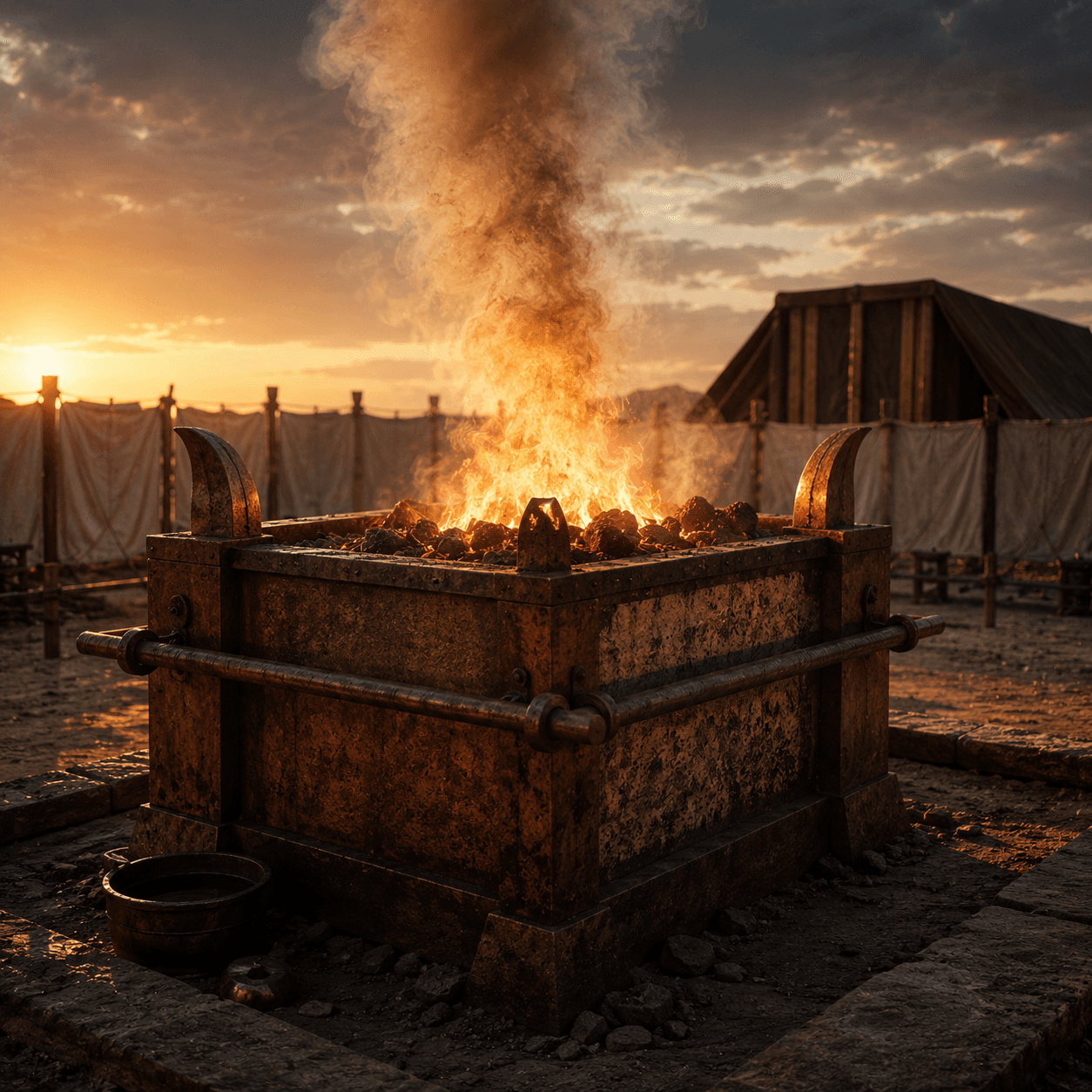
Christ is the gate. Step through it — accept Him — and the first thing you meet is not a throne but an altar: the altar of burnt offering, where a lamb is killed. The sinner brought the animal himself, laid his hand on its head (Leviticus 1:4), and in that gesture confessed and transferred his guilt onto the substitute; then the lamb died in his place. Every morning and evening, year upon year, the courtyard ran with the blood of a stand-in — one long, repeated sermon with a single subject:
“Behold the Lamb of God, which taketh away the sin of the world.”
— John 1:29, KJV
To enter the gate and stand at that altar is what Scripture calls justification — you are wrapped in the white linen of Christ’s righteousness, your guilt laid on the Lamb. The gate itself, and the door of the tent, and the inner veil were all woven of the same four colors and gold — blue for obedience, scarlet for sacrifice, purple (the two combined) for royalty, white for righteousness, gold for divinity — every thread of them Christ. And just past the altar stood the laver, a basin of water for washing. The blood deals with the guilt; the water deals with the life. This is the new birth, the cleansing that follows forgiveness (Titus 3:5) — not an optional extra but the next step in. Many a modern gospel stops dead at the gate: accept the sacrifice, declare yourself saved, and carry on unchanged. The pattern in the sanctuary says the door is the beginning of the ministry, not the end.
Daily bread, daily light
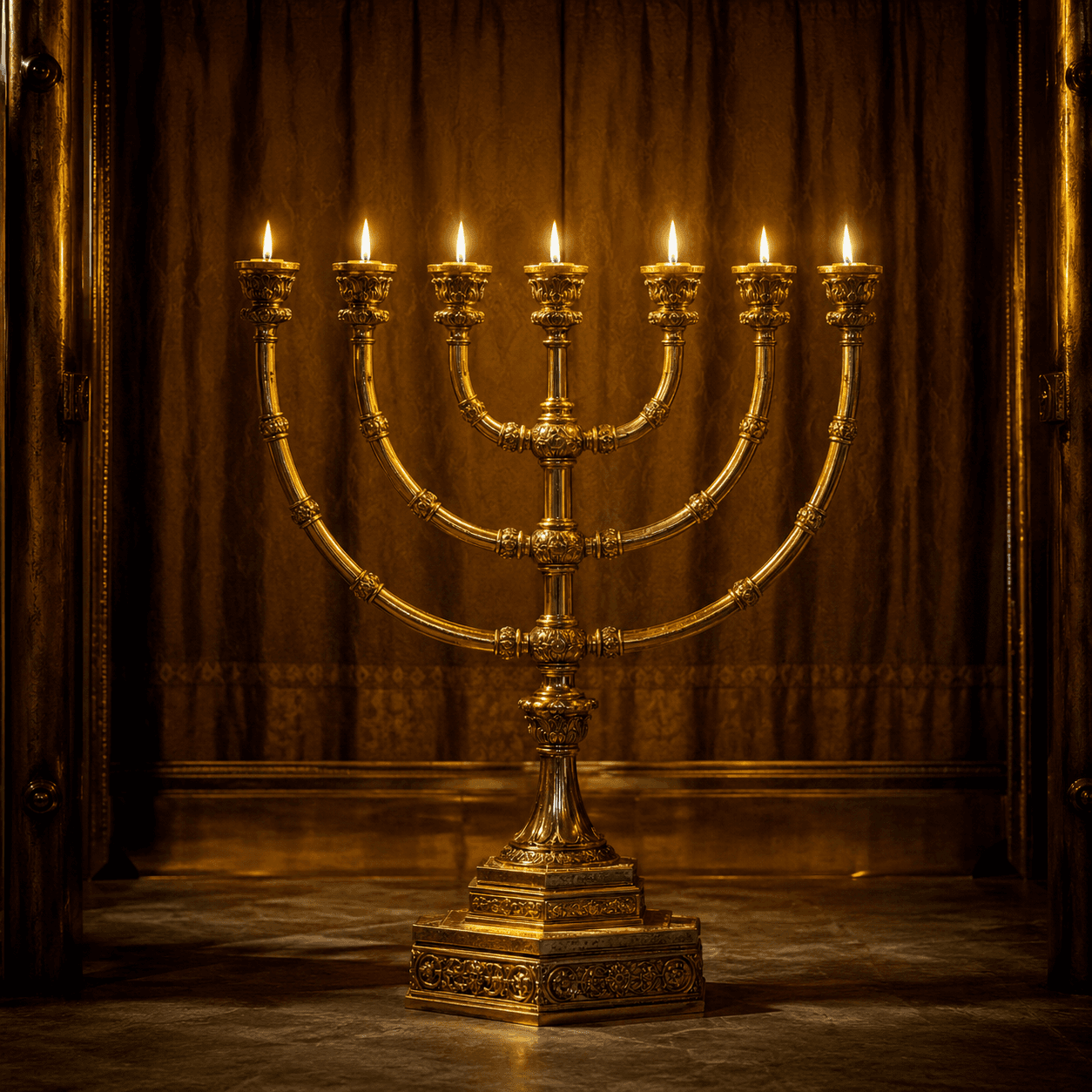
Inside the tent itself, in the first room — the holy place — stood three pieces of furniture, and each one is Christ kept company with day by day. On one side, the golden candlestick, its seven lamps burning continually:
“I am the light of the world: he that followeth me shall not walk in darkness, but shall have the light of life.”
— John 8:12, KJV
The oil that fed those lamps was God’s own Spirit — His very life and presence poured into His people, by which Christ Himself shines in them. On the other side stood the table of shewbread, twelve loaves always before the Lord — “I am the living bread which came down from heaven” (John 6:51). And in the centre, before the veil, the golden altar of incense, its fragrant smoke rising day and night, mingling with the prayers of the people and carrying them up made acceptable through Christ (Revelation 8:3-4). Light, bread, and incense: Christ as the daily light of the mind, the daily food of the soul, and the one through Whom every prayer reaches the Father. This room is the Christian life itself — what Scripture calls sanctification, the daily walk after the gate.
The blood kept a record
Here is the part most readers have never been shown, and it is the hinge of everything that follows. When a sinner confessed over the lamb and the lamb was slain, the priest took its blood and carried it into the sanctuary, applying it within the holy place. Sin did not simply vanish at the altar; it was transferred— from the sinner, to the lamb, to the priest who bore it, and on into the sanctuary, where it was, in effect, placed on record. Day after day, every confessed and forgiven sin was carried in and registered there.
And that record is good news, not bad. A sin written down in the sanctuary is a pardoned sin — it is there precisely because it has been confessed and covered by blood. The longer that ledger, the better; it means your sins are off your own head and under the blood of the Lamb. The sanctuary became the great repository of forgiven sin, waiting for the day it would all be dealt with finally. Which brings us to the one day in the year that the whole system was building toward.
Once a year: the day of atonement
Behind a second veil lay the most holy place, and into it the high priest went only once a year, on the Day of Atonement — Yom Kippur — and never without blood (Leviticus 16; Hebrews 9:7). It was the most solemn day in Israel’s calendar: a day of judgment and final cleansing. The priest wore bells on his robe and a rope about him, for if he entered the presence of a holy God with unconfessed sin he would die there, and they would need to draw him out.
That day, two goats were chosen. Lots were cast: one became “the LORD’s goat,” the other the scapegoat — in Hebrew, Azazel. The LORD’s goat was slain, a type of Christ, and its blood carried into the most holy place to cleanse the sanctuary of the whole year’s accumulated record of sin:
“For on that day shall the priest make an atonement for you, to cleanse you, that ye may be clean from all your sins before the LORD.”
— Leviticus 16:30, KJV
The scapegoat, by contrast, was not sacrificed and made no atonement — “without shedding of blood is no remission” (Hebrews 9:22). It was led away alive into the wilderness, never to return. In the pioneer reading it stands for Satan, the instigator of the whole tragedy of sin, on whom the responsibility for the confessed and forgiven sins of God’s people is finally rolled back at the very end — the originator of the crime bearing his own guilt at last, after the redeemed are cleared. He is not a second saviour; he is the defendant.
And there, in the most holy place, sat the heart of it all: the ark, with the Ten Commandments — the very law humanity had broken — inside it, and over them the golden lid called the mercy seat, where the glory of God appeared. The broken law, covered by mercy. Justice and mercy in one box:
“Mercy and truth are met together; righteousness and peace have kissed each other.”
— Psalm 85:10, KJV
When the cleansing was finished, the people stood acquitted — the year’s record blotted out, the camp clean before God. It was, in type, the day the books were balanced.
Our high priest, now
All of that was the shadow. Here is the substance. When Jesus died, the veil of the earthly temple tore from top to bottom (Matthew 27:51) — God’s own hand ending the shadow-service, because the Lamb it pointed to had come. The blood of bulls and goats had only ever been a promissory note; now it was paid:
“But Christ being come an high priest of good things to come… by his own blood he entered in once into the holy place, having obtained eternal redemption for us.”
— Hebrews 9:11-12, KJV
Not with the blood of animals but with His own, Christ entered the real sanctuary — “not into the holy places made with hands… but into heaven itself, now to appear in the presence of God for us” (Hebrews 9:24). The cross paid the price; but the work did not stop at the cross. Christ rose and became our living High Priest, and He has been ministering on our behalf ever since:
“Wherefore he is able also to save them to the uttermost that come unto God by him, seeing he ever liveth to make intercession for them.”
— Hebrews 7:25, KJV
This is why “if any man sin, we have an advocate with the Father, Jesus Christ the righteous” (1 John 2:1). And it is why rebuilding the earthly temple and restarting its sacrifices — as some still long to do — would be a denial of the cross, not an honour to it: to bring back the blood of lambs is to say the blood of the Lamb was not enough (Hebrews 10:12, 18). The shadow is over because the real Priest is at work. The only question left is where in that sanctuary He is working — and that question, it turns out, is the most fought-over date in modern prophecy.
Part Two — 1844 and the Final Onslaught
“Then shall the sanctuary be cleansed”
If the earthly sanctuary had its yearly day of cleansing, the heavenly one has its day too — and Scripture dates it. In vision Daniel heard the question of how long the desolating powers would tread down the sanctuary, and the answer was a number:
“Unto two thousand and three hundred days; then shall the sanctuary be cleansed.”
— Daniel 8:14, KJV
In prophecy a day stands for a year — the principle God states plainly twice over (Numbers 14:34; Ezekiel 4:6). So this is a span of 2,300 years. The starting point is fixed in the very next chapter, where the angel returns to give Daniel the “seventy weeks” — 490 years “determined” (literally cut off) from the longer 2,300 and assigned to Israel and the Messiah (Daniel 9:24-27). That count began with the decree to restore and build Jerusalem, given by Artaxerxes in 457 BC (Ezra 7). From there the 490 years land with startling precision on the Messiah: the anointing at His baptism in AD 27, the cross “in the midst of the week” in AD 31, and the gospel turning to the Gentiles in AD 34. The first stretch of the prophecy pinpoints Christ so exactly that ancient rabbinic tradition pronounced a curse on any who would so much as calculate it — lest, the curse ran, his memory rot for finding the Messiah in its pages. The same calculation, run to its end — 457 BC plus 2,300 years — arrives at 1844.
So in 1844 the antitypical Day of Atonement began — the heavenly day of cleansing and judgment toward which every Yom Kippur had pointed. Christ, Who at His ascension had entered the holy place of the heavenly sanctuary, moved into its most holy place to begin the final work of blotting out the recorded sins of His people. Think it through and there is no other way to read it. The earthly priest served the holy place daily and entered the most holy only on the day of atonement. Christ “by his own blood” entered the sanctuary at His ascension — and it had to be His own blood, for the priest never served with any other. He could not have entered the most holy at His ascension and left the holy place unministered; the pattern requires the holy place first, then the most holy “at the time of the end.” The only date the prophecy gives for that second transition is 1844.
Why a single date is under attack
Here is something worth sitting with. The first half of this same prophecy — the half that identifies the Messiah — was buried under a rabbinic curse so that no one would calculate it and find Jesus. Is it really so strange that the last half, which raises up a people to set Christ back in His rightful place as the world’s only High Priest and only Saviour, would draw an equal and opposite fire? It has. And the campaign against 1844 is not loud; it is quiet, and it works on the text itself.
Look at the seam where the doctrine lives. The King James renders Hebrews 9:12 that Christ “entered in once into the holy place” — the Greek is hagion, the ordinary word for the sanctuary or its first room. The word the same writer uses for the most holy, just nine verses earlier (Hebrews 9:3), is different — hagia hagion, the holiest of all. Yet some modern Bibles quietly change Hebrews 9:12 to read that Christ entered “the Most Holy Place” at His ascension — collapsing the two rooms into one. Watch what that does: if Christ went straight into the most holy in the first century, then nothing special happens in 1844, there is no second transition, no antitypical day of atonement, no judgment-hour message, and no peculiar people raised to give it. The Greek does not demand the change. The doctrine is simply what gets lost when it is made.
The same years that the cleansing began saw the launch of the very tools that would weaken Christ in print. Around 1844 the manuscript known as Codex Sinaiticus was being brought to light at the monastery on Mount Sinai — the text that, with its companion, became the spine of nearly all the modern critical translations, and with it a long train of readings that soften the deity of Christ and His standing as the one Saviour. (The parallel campaign on the Saviour’s identity — what the modern versions do with the Godhead — is the subject of The God of the Bible.) Even the first gospel promise was not left untouched: where the Hebrew of Genesis 3:15 says the seed of the woman — Christ — “it shall bruise thy head,” the Latin tradition of Rome altered it to “she shall crush thy head,” quietly moving the victory from the Son to Mary. The attack runs from Genesis to Hebrews, and it always moves in one direction: away from Christ.
The books were opened
Daniel saw what that day of cleansing looks like from heaven’s side — a courtroom convening before the Second Coming:
“I beheld till the thrones were cast down, and the Ancient of days did sit… the judgment was set, and the books were opened.”
— Daniel 7:9-10, KJV
This is a judgment that precedes the return of Christ — for when He comes, His reward is already with Him “to give every man according as his work shall be” (Revelation 22:12). The cases must be settled first. And Scripture is plain about where such a review begins: “judgment must begin at the house of God” (1 Peter 4:17). The books are opened, and the record of every professed believer is examined — “for God shall bring every work into judgment” (Ecclesiastes 12:14).
And now hear what kind of news this is, because almost everyone hears “investigative judgment” and flinches. For the person whose sins are confessed and recorded in the sanctuary, the judgment is the moment those sins are blotted out:
“Repent ye therefore, and be converted, that your sins may be blotted out, when the times of refreshing shall come from the presence of the Lord.”
— Acts 3:19, KJV
Zechariah was shown the scene exactly. Joshua the high priest stands before the angel in filthy garments, and Satan stands at his right hand to accuse him — and the Lord rebukes the accuser, strips off the filthy garments, and says, “I have caused thine iniquity to pass from thee, and I will clothe thee with change of raiment” (Zechariah 3:1-4). That is the judgment for those who are Christ’s: the Advocate answers every charge with His own blood, the accuser is silenced, and the believer stands clothed in white — not as a forgiven sinner merely, but, the record cleared, as one who had never sinned at all. “As far as the east is from the west, so far hath he removed our transgressions from us” (Psalm 103:12). The standard of the court is the law of liberty (James 2:12) — the same law the believer now keeps not to be saved but because he is, and loves the One Who wrote it (John 14:15). This is why the final message to the whole earth is a summons to judgment that sounds, of all things, like worship:
“Fear God, and give glory to him; for the hour of his judgment is come: and worship him that made heaven, and earth, and the sea, and the fountains of waters.”
— Revelation 14:7, KJV
A year heaven marked
Out of the deep disappointment of 1844 — when a people who had expected Christ to return found instead that the date marked a change in His ministry, not His coming — rose a movement to carry this judgment-hour message to the world, the sweet-then-bitter little book of Revelation 10 lived out in real time. And the timing around that year is hard to wave away. While heaven was opening the books, the great counter-movements of the modern age were being born, almost to the season, each one whispering some version of remove the Creator, remove the Judge.
In those very years Karl Marx was writing the manuscripts that fed the creed of state atheism — a gospel whose first article is that there is no God to fear or face. In 1844 Charles Darwin set down the first full essay of the theory by which the Creator would be written out of His own creation. That same year, 1844, in Persia, a figure called the Báb — the word means “the gate” — proclaimed the dawn of a new universal religion; from him came the Báhá’í faith, whose central tenet is the unity of all religions, and which would one day hold one of the most prominent religious presences at the United Nations. A wave that said, in chorus, there is no Creator, there is no Judge, and all faiths are one crested at the exact hour heaven was saying, “Fear God, and give glory to him… and worship him that made heaven, and earth.” One date, two messages, moving in opposite directions.
The counterfeit unity
Set the two messages side by side and the whole modern landscape comes into focus. The judgment-hour message is a message of separation — “Come out of her, my people, that ye be not partakers of her sins” (Revelation 18:4). Against it, in the same era, rose a counterfeit: a message of unity — all religions one, all roads up the same mountain, every doctrine that divides to be quietly retired. It is everywhere now, and its pedigree is on the record.
The Báhá’í creed opens with “the fundamental unity of all religions” and “independent investigation of truth”; its temple keeps three books side by side — the Bible, the Qur’an, and the writings of Bahá’u’lláh — and its message to the contending peoples of the earth is, in its own words, to “set your faces toward unity” and root out whatever is the source of contention. Alongside it runs the older occult stream that fed the modern New Age: Helena Blavatsky’s Theosophy, and after her Alice Bailey, whose books were issued by a house she first named, openly, the Lucifer Publishing Company — later softened to Lucis Trust — and dictated, she said, by a spirit-guide. The teaching is candid about its aim:
“The day is dawning when all religions will be regarded as emanating from one source… a new church of God, gathered out of all religions and spiritual groups, will unitedly bring to an end the great heresy of separateness.”
— Alice Bailey, on the coming world religion (on the record)
Read that last phrase again: the great heresy of separateness. What heaven calls the loud cry — come out and be separate — this movement calls the one great heresy to be stamped out. The architects say so plainly. Robert Muller, an Assistant Secretary-General of the United Nations, dreamed aloud of a “convergence of the different religions” and a worldwide spiritual ecumenism; the New Age writers speak of “the elimination of sectarian separativeness” and an “increasing distaste for reliance on hard and fast doctrine and dogma.” And when a doctrine refuses to dissolve — when it draws a line instead of erasing one — the instruction is simple: eliminate what is “non-essential.” The doctrine that most stubbornly separates, the sign of allegiance to the Creator written into the heart of His law, is the Sabbath. It is no mystery which commandment a religion of total unity must dispose of first.
One more thread, because it explains the spiritual logic underneath. In this stream the figure of “the Christ” is not the Son of God at all but a coming world-teacher; the “luminary” they invoke is, by Blavatsky’s own writing, a form of the light- bearer; even the Marian devotion is read by them as the old goddess Isis under a new name. This is not the Christ of Scripture. It is a counterfeit wearing His title — which is exactly what Scripture warned would come, “another Jesus… another spirit… another gospel” (2 Corinthians 11:4). The whole point of studying the real sanctuary is to be able to tell the true High Priest from the impostor.
“Change or die”
There is a darker register beneath the talk of unity, and honesty requires naming it, because Scripture said the end of this road is not a hug but a sword (Revelation 13:15). The same literature that longs to dissolve “separateness” speaks, with unsettling calm, about what is to be done with those who will not dissolve.
On a granite monument that stood for decades in Georgia, the so-called American Stonehenge, the first of ten “guides” for a coming age of reason read: Maintain humanity under 500,000,000. The media magnate Ted Turner mused publicly that the earth’s population should fall to a fraction of its present number. Prince Philip put on record his wish, “in the event I am reincarnated,” to “return as a deadly virus… to reduce overpopulation.” The futurist Barbara Marx Hubbard wrote that “no worldly peace can prevail until the self-centered members of the planetary body either change or die.” In the Bailey material the “fundamentalists” who resist the new order are likened to a cancer cell or a germ to be cut out, with the assurance that “much destruction will be permitted.” The philosopher Mortimer Adler argued that a Christianity claiming supernatural revelation is “divisive… and should not be tolerated.” Former insiders have warned that those who refuse the coming mark are to be targeted for what is benignly called re-education. These are not anonymous cranks; they are, in their fields, prominent voices, and the quotations are on the public record.
Scripture is not surprised by any of it. “They shall put you out of the synagogues: yea, the time cometh, that whosoever killeth you will think that he doeth God service” (John 16:2). The image of the beast is to decree “that as many as would not worship the image of the beast should be killed” (Revelation 13:15). The plan to thin out the resisters is the oldest plan there is, dressed for a new century. But here is the promise that runs alongside it, and it is the reason a Christian can read those quotations without fear:
“A thousand shall fall at thy side, and ten thousand at thy right hand; but it shall not come nigh thee.”
— Psalm 91:7, KJV
In Egypt the last of the plagues fell on the oppressor and passed over the homes marked by blood. God still knows how to make a difference between those who serve Him and those who do not (Malachi 3:18), and He has promised that the swift witness in the judgment will be against the sorcerers and the oppressors, not against the ones who feared His name (Malachi 3:5). The threats are real. So is the shelter.
The mark, the day, and Rome on Rome
All of this converges, at last, on a single question of worship, and it wears a day on its face. There are, in the end, only two commandment-keeping movements that span the whole earth, and they give opposite commands. One says: keep the day I have appointed, because I am the authority in your life. The other says: keep the day God appointed, because He is. The remarkable thing is that the first movement freely admits the second is right about the Bible.
In the Apostolic Letter Dies Domini (1998), Pope John Paul II called on Christians to “strive to ensure that civil legislation respects their duty to keep Sunday holy,” while granting that Sunday rest came “by tradition” and that it was “only in the fourth century” that the civil law of the Roman Empire, under the day of the sun, gave it standing. The same year, the letter Ad Tuendam Fidem sharpened canon law so that one who rejects a doctrine “definitively” held by Rome is to “come to his senses” or be punished with “an appropriate penalty” — the document closing in the first person plural of deity, “given at Rome… in the twentieth year of our pontificate.”
And Rome has never hidden the underlying claim — it boasts of it. Cardinal James Gibbons’ catechetical writings stated flatly that “you may read the Bible from Genesis to Revelation, and you will not find a single line authorizing the sanctification of Sunday,” and that the keeping of Saturday would make the Seventh-day Adventist “the only consistent Protestant.” The Catholic Mirror, Gibbons’ own organ, ran a series of editorials in 1893 proving the Sabbath from Scripture precisely so it could claim the authority to have changed it — and noting, in an editor’s aside, that it was on this very point that the Reformation foundered at the Council of Trent, where the argument was made that Protestants who keep Sunday (a tradition) while professing Scripture alone thereby prove they follow the church’s tradition after all. The challenge has been reissued in our own time. A Roman Catholic source put it, in December 2003, with a bluntness worth quoting:
“Either the Catholic Church is right, or the Seventh-day Adventists are right. There can be no other choice.”
— Roman Catholic challenge, reissued 2003 (on the record)
That is not our claim about Rome; it is Rome’s claim about itself, and about the one body of Christians it recognizes as its consistent opponent on the Sabbath. What the mark of the beast is, how the day became the test, and how the powers of Revelation 13 assemble around it — that is the burden of The Seal and the Mark and The Cup the World Drank. The point here is only to show that the sanctuary doctrine and the Sabbath are the two truths the whole onslaught is organized to remove, because together they set Christ back where He belongs: the Creator to be worshipped, and the High Priest to be trusted.
The machinery is already in place
None of this requires some far-off change in the world to become possible; the legal scaffolding for a crisis of conscience is already built. In the years after September 2001, even mainstream reporting noted how quickly long-standing protections could be set aside: detention without charge, secret military tribunals, eavesdropping on a defendant’s conversations with his own lawyer, no appeals — with an attorney general declaring that certain accused “do not deserve the protections” of the constitution, and a precedent on the books from the Second World War of secret trials and executions upheld by the highest court. When a government can hold a person without charge, listen to his privileged conversations, and try and condemn him in secret, the apparatus a future test would need is no longer hypothetical. Scripture told us the road runs through tribulation — and told us how to walk it:
“In the world ye shall have tribulation: but be of good cheer; I have overcome the world.”
— John 16:33, KJV
Here is the patience of the saints
Lay it all out and the contest is stark, but the outcome is not in doubt. On one side, a counterfeit unity that would dissolve every line, retire every dividing doctrine, and, where that fails, remove the ones who will not dissolve. On the other, a people described in a single sentence:
“Here is the patience of the saints: here are they that keep the commandments of God, and the faith of Jesus.”
— Revelation 14:12, KJV
Daniel was told how it ends: “the saints of the most High shall take the kingdom, and possess the kingdom for ever, even for ever and ever” (Daniel 7:18), and “the God of heaven… shall break in pieces and consume all these kingdoms, and it shall stand for ever” (Daniel 2:44). The thrones cast down, the kingdoms of murderous men ground to powder, the meek inheriting at last. The Advent pioneers who first traced this prophecy out of the disappointment of 1844 understood that to stand with such a message would mean being called a sect and worse — and they counted it worth everything, because the alternative was to give up Christ as the only High Priest, the only Saviour, and the soon-coming King. The invitation has never changed. “Choose you this day whom ye will serve” (Joshua 24:15). There is freedom in the choosing; God forces no one. But the facts, He lays plainly on the table, and then He waits.
A note on what is being critiqued
This study draws hard lines, so let it be just as clear about what it does not mean. It is not a claim that one denomination owns Christ, or that a card of membership saves anyone — the sanctuary knows only one door, and His name is Jesus. The quarrel with Rome is with a system and its claims over conscience, never with Catholics, who are among the most sincere believers on earth and whom Scripture itself addresses as God’s own people still inside her walls: “Come out of her, my people” presumes they are His. The quarrel with the ecumenical and New Age movement is with an agenda on the public record, not with the many decent people drawn into it by a genuine longing for peace. The quarrel with the altered translations is with the changes, not with the millions who read them in good faith and love the Lord through them. And the great mass of sincere Sunday-keeping Christians are not the enemy in any of this — they are simply people who were handed a gospel that stops at the gate, by teachers they trusted, and who have never been shown the rest of what their High Priest is doing for them. This is an invitation to see it. Nothing more, and nothing less.
No condemnation
Strip away the diagrams and the dates and the long campaign against them, and the sanctuary leaves one plain thing in your hands. There is a law, and you have broken it. There is a Lamb, and He has died for it. There is a Priest, and He is pleading your case now. And there is a day — already begun — when the books are opened and the record of every confessed sin is wiped clean, and you stand before God clothed in white as though you had never sinned at all. That is not a thing to dread. It is the best news in the world:
“There is therefore now no condemnation to them which are in Christ Jesus.”
— Romans 8:1, KJV
The pattern in the sanctuary was always a love letter in furniture: let them make me a sanctuary, that I may dwell among them. God wanting back in. The whole long ritual of blood and linen and incense was His way of saying, across the centuries, that He had found a way to do it justly — to forgive without pretending the law away, to dwell with sinners without ceasing to be holy. The way is a Person. And every effort to bury the date, alter the text, dissolve the doctrine, and silence the people who carry it only underlines how much is at stake in that one room of the sanctuary where He is working now. Bring Him your sins; let them be written into the sanctuary under His blood; and there is nothing in the judgment, or in the world, left to fear. The door is still open. He is still inside, waiting.
Sources & further reading
A law, a penalty, a Substitute
- 1 John 3:4; Romans 4:15; 6:23 — sin is the transgression of the law; its wage is death.
- Exodus 31:18; Deuteronomy 10:2-5; 31:24-26; Galatians 3:19 — the moral law (in the ark, by God's finger) vs. the ceremonial law (beside it, by Moses, added because of transgression).
- Romans 3:31; Ephesians 2:8-9; Hebrews 10:16 — the cross establishes the law; saved by grace; the law written on the heart.
The sanctuary as the plan of salvation
- Exodus 25:8, 40; Hebrews 8:1-2, 5; 9:24 — a sanctuary so God could dwell with them, built by exact pattern as a copy of the true heavenly tabernacle.
- John 10:9; 1:29; Leviticus 1:4; Titus 3:5 — the one gate (Christ); the altar and the lamb (the transfer of sin); the laver (the new birth).
- John 8:12; 6:51; Revelation 8:3-4 — the holy place: light, bread, and incense, the daily life with Christ.
- Leviticus 16:16, 22, 30; Hebrews 9:7, 22; Psalm 85:10 — the day of atonement; the LORD's goat (Christ) and the scapegoat/Azazel (Satan); the broken law under the mercy seat.
- Matthew 27:51; Hebrews 9:11-12, 24; 7:25; 10:12, 18; 1 John 2:1 — the veil rent; Christ entered the real sanctuary by His own blood and ever lives to intercede.
1844 and the investigative judgment
- Daniel 8:14; Numbers 14:34; Ezekiel 4:6 — 'unto 2,300 days then shall the sanctuary be cleansed'; the day-for-a-year principle.
- Daniel 9:24-27; Ezra 7 — the seventy weeks 'cut off' from the 2,300, from the decree of 457 BC, pinpointing the Messiah (AD 27 / 31 / 34); the count reaching 1844.
- Daniel 7:9-10, 13-14; 1 Peter 4:17; Ecclesiastes 12:14; Acts 3:19; Zechariah 3:1-4; Revelation 14:7; 22:12 — the books opened, judgment beginning at the house of God, sins blotted out, the accuser silenced.
- Hebrews 9:3, 12 — hagion ('holy place') vs. hagia hagion ('most holy'): the textual change that collapses the two rooms and erases the 1844 transition.
The onslaught — documented
- The 1844 convergence — the Advent movement out of the Great Disappointment (Revelation 10), against the same-era rise of Marx's manuscripts, Darwin's 1844 essay, the Báb (1844 / Báhá'í), and the surfacing of Codex Sinaiticus.
- The counterfeit unity — Báhá'í 'unity of all religions'; Theosophy (Blavatsky); Alice Bailey / Lucifer Publishing Company → Lucis Trust ('the great heresy of separateness'); Robert Muller and UN spiritual ecumenism — set against Revelation 18:4 ('come out of her') and 2 Corinthians 11:4.
- 'Change or die' — the Georgia Guidestones inscription; Ted Turner; Prince Philip; Barbara Marx Hubbard; the Bailey 'cancer-cell' rhetoric; Mortimer Adler — set against John 16:2; Revelation 13:15; Psalm 91:7; Malachi 3:5, 18.
- The Sunday law and Rome on Rome — Dies Domini (1998); Ad Tuendam Fidem / Canon 1436; Cardinal Gibbons; the Catholic Mirror (1893) and the Council of Trent; the 2003 'either the Catholic Church is right, or the Seventh-day Adventists are right' challenge.
Related on this site
- The Day the Church Set Aside — the law's permanence and the day the onslaught most wants gone.
- The God of the Bible — the parallel campaign on the identity of Christ in the modern translations.
- The Seal and the Mark — how the day becomes the test, and the powers of Revelation 13.
- The Cup the World Drank — Babylon, Rome, and the wine of false worship.
- Daniel and Revelation — the prophetic frame: the kingdoms, the little horn, the 2,300 days.